Martin Luther King Jr.'s speech is one of the most well known speeches ever given. In it he describes his dream for racial equality for all those who reside within the United States and that he and the his movement would not stop until the people were given complete and utter racial equality where they could attain the rights promised them by the Constitution (Life, Liberty, and the Pursuit of Happiness). He begins his speech by declaring that the first significant move toward racial equality began when the slaves were freed under the Lincoln's Emancipation Proclamation. Since then however, there has been no forward progress at all which King attributes to the lack of freedom of the negro people due to segregation and discrimination. He states that due to those factors the negro people are forced to live in poverty, exiled in their own land. King digs further into America's history citing that since its foundation America was designed that ALL men be equal as stated in the Constitution, but since then they have written the negro people a bad check entitled insufficient funds. Refusing to believe that the Bank of Justice is bankrupt King declares his speech as a way of trying to collect the check and now is the time for the american people to honor it and that he and his movement are not just letting off steam but are here to stay until their demands are met. In regard to his movement King urges that negroes keep thier protests peaceful and to do so without bitterness or hatred ofr whites as their freedom depends on each other. With that statement King calls for an end to the brutality on the part of the white people in regard to the discrimination, lack of sufferage, and the physical violence displayed toward negroes. King concludes his speech stating that his dream is rooted within the American Dream, that whites and blacks will be able to coexist peacefully and that people will be judged by their character and not the color of their skin. With this statement one of the most well known speeches of his era is drawn to a close forever immortalizing Martin Luther King Jr. as one of the best Civil Rights advocates in history.
Monday, January 20, 2014
LAD #25: Dawes Act
The Dawes Act was essentially an idea the U.S. government came up with to further destroy the native indian tribes in their country. The Dawes act was designed to create more land for americans to purchase while destroying a sacred Native American custom. The custom that was destroyed by this act was the idea that the land on which the tribes lives was not personally, but comunally owned. The Dawes Act, sponsered by senator Henry Dawes (for who it was named), gave the government the power to divide up the comunally owned land and dispense it to each individual indian. Whatever land was left over would be sold either to Joe Public or more likely the expanding businesses of the Robber Barons. This act served two interests of the american people which was the assimilation of the indian tribes and another reason to take more indian land. The way land was distributed among the indians was basically heads of a family received the most (about a quarter of a section) then those over eighteen (one eighth of a section) and those under eighteen (one sixteenth of a section). In special cases such as religious buildings would be elgible to receive more land, up to one hundred and sixty acres. In return for their losses indians were given citizenship in the United States and all the protection that the Consitution provides, save those dealt with in the Jackson Administration. This was a program headed by the Secretary of Interior whose administration would resolve any disputes under the act.
LAD #24: Cross of Gold Speech
One of the most famous speeches was spoken by William Jennings Bryans, and it was the "Cross of Gold" speech. Bryan spoke in favor of a highly controversial topic in the United States: Bimetallism, the idea that both gold AND silver should be coined instead of just gold. It was be the speech that would send him into the presidential nomination for the Democratic party. In the speech he says that in no way is this speech an attack on the position of the Republican Party who does not support bimetallism. After,Bryan begins to repel Republican accusations against bimetallism, starting with their claim that it will interfere with the businesses of America. Bryan responded to this claim by saying that Republican practices already interfered with business as the monopololies of the Robber Barons prevented any new businesses from taking root since big business opposed bimetallism. Bryan then responds to another claim that the democratic party passed an illegal income tax law which he defends on the basis that the law was declared unconstitutional by a single judge and people cannot predict when a judge will change his mind. He concludes his argument by stating that any man unwilling to pay his fair share to live in our nation that he did not deserve to live here. He goes on to affirm his party's position opposing national Bank just as Andrew Jackson did due to his opposition to the Bank of the United States. Another aspect of the Gold Standard that Bryan makes public is that the gold standard is almost entirely controlled by the Republican party. Bryan then questions Mckinley, who is a Republican and his election on the basis that his platform was to maintain the gold standard until a time at which it could be replaced with bimetallism by international agreement. Bryan closes his speech restating his party's position of opposing the gold standard and gives his famous quote: "you shall not press down upon the brow of labor this crown of thorns. You shall not crucify mankind upon a cross of gold."
LAD #23: The Populist Party Platform
Thursday, January 9, 2014
LAD #22: McKinley's War Message
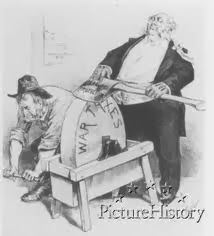
William McKinley's War Message focused mainly on the crisis between Cuba and Spain. It addressed how that crisis warranted intervention by the United States due to the sympathy American people have for the Cubans and also the threat the war posed to American business' on Cuba. McKinley's War Message is the main cause of the Spanish American war. McKinley stated in his address to Congress that Cuban conflict had spread to America, hurting its trade, damaging businesses and horrifying the people. McKinley states that while there is many options that could be pursued regarding the conflict in hopes of finding a solution all of which include intervention on the part of America whether as a neutral party or ally, McKinley leaves the decision up to Congress but not before suggesting the impartial negotiator idea. Mckinley advocates intervention as he feels it is justified for four major reasons which include the fact that the conflict is taking place right outside of american territory, that the citizens of Cuba deserve peace, the fact that the war has harmed U.S. trade in the region, and the fact that a mysterious tradegedy took place within the borders of the conflict area. McKinley declares that in the name of humanity the war must stop. He ends his speech asking congress to grant him the power to utilize the armed forces to cease the conflict between the two nations and to be able to set up a stable government in the region. McKinley concludes and says that the decision is up to Congress now and he hopes a solution will be reached.
Wednesday, November 20, 2013
LAD #18: Dred Scott Decision
In the case of Scott vs Sanford, Chief Justice Roger Taney made two important court decisions that would anger abolitionists and anti-slavery activists across the nation. He stated that Negroes did not receive the full benefits of the Constitution as they had come from another country as slaves. And, thereby could not sue in a federal court. Second, Roger Taney declared the Missouri Compromise unconstitutional, saying if a citizen takes his slaves into a free land, he cannot have them removed as that would be denying that citizen his property. Taney finished with crushing Scott's last hope for freedom by saying that if a slave runs away to a free state it is based on the laws of that state whether or not to send him back. The overall outcome of this case was that the court was in favor of Sanford and the Missouri Compromise was declared unconstitutional.
Tuesday, November 19, 2013
LAD #16: Frederick Douglass "5th of July"
Frederick Douglas states in his speech that Americans celebrating the 4th of July is absurdity, since the celebration is all about being free from tyranny while whites still hold power over black slaves. He also states that as long as the blacks are property of the whites, America will continue making a mockery of itself as a country who lives a lie, claiming freedom for all but still supporting slavery. Douglass concludes by saying that at the very least black's must be made equals as they have carried on for decades doing the jobs as white men have while still having to prove their equality.
LAD #17: Sojourn Truth "Ain't I a Woman"
In Sojourner Truth's Ain't I A Woman Speech, she keeps herself relaxed while still making her case for women's and negros' rights. She states that she can do just about anything as well as a man but is still not given the same treatment, while also doing things men do not do, such as childbirth and child rearing. She dismisses all the reasons she has been told as to her why women are not or cannot be equal. She defeats each argument, whether religion or reason with logic and calls those who refuse to accept equality for all ignorant, racist, and even sexist.
Sunday, November 17, 2013
LAD #15: Lincoln's Gettysburg Address
In his Gettysburg address, President Lincoln reminds the troops of what they are fighting for: a single unified nation. He goes on to state that there is no commemoration possible that will honor what those fighting have died for. This address is the best possible way to commemorate those already fallen while convincing the remaining others that the outcome will remain worth the effort. Also, that their victory will signal a return of their nation to what was envisioned by the founding fathers and the nation will return to its former glory, now in danger of being lost in this vicious war.
LAD #14: President Lincoln's First Inaugural Address
In his First Inaugural Address, Lincoln stated that he never did or would intend to do anything about the slavery issue in the south. He did not view it as his duty as president to deal with the problem. He believed it was Congress' duty as the representatives of the nation, and that they should decide whether or not to outlaw slavery. President Lincoln did make another comment on the issue, saying that many states were in favor of the fugitive slave law even though there was still some controversy on the issue of whether the duty of capturing them resided with the federal or state government. He stresses in this Address that his major goal as president would be preserving the union of the nation and that he will carry out that duty as he sees fit, using force only when required. He then goes on to state that his administration will strive to pass or modify laws that will try to cede some provisions to the minority opinion as well, even though (he says) no law can please every individual. This is the case with the slavery issue where some states support abolition of the slaves and others do not. He closes by urging the nation to think hard on the slavery issue, reminding them that it was even before the constitution the nation was held together only by unity and even now, without they will be destroyed. He finishes by stating that he will neither 'condemn nor condone' their actions towards each other as long as it is within his power to "preserve, protect, and defend" the nation from itself.
Wednesday, November 13, 2013
LAD #13: John Calhoun's Speech
John Calhoun's speech focuses on how at the beginning of the creation of the constitution and the three-fifths compromise,the representation between the North and South was balanced in government. Since then, he states that the North has gained the upper hand in congress through use of taxes more heavily taxing the South. He also mentions the acquisition of territories desired by the North as free, and the arrival of new states from areas like the Oregon territory, Minnesota, and Mexican territories which. The problem with these territories is that if labeled free states, they will decrease the southern say in goverment allowing them only 25%t of the overall Congress. Calhoun continues on to talk about the new states and how they are not offered the possibility of joining the southern states in their induction into the union. He is now accusing the North of trying to weaken the southern states. Calhoun mentions the import tariffs imposed on the southern states by the north using it to further expand their infrastructure. The last issue Calhoun brings up in his speech is the slavery issue. He also talks about the growing abolitionist movement which he says is the major source for a poor relations between the two sections of the country. He says the issue may be "forcing the south to choose between abolition and secession". The more likely outcome would be secession (as we will soon see in the Civil War) as the southern economy depends heavily on slave labor. Calhoun believes the only way to avoid secession is if the stronger, richer, northern states drop the slavery issue and allow the southern states their space to develop. This meant the southern stattes would get to receive territories, fewer taxes and escaped slaves had to be returned. He says the meeting of the demands is the only way to avoid further conflict between the two. Calhoun's speech clearly reflects the growing sectionalism in the U.S. which will be a main reason for conflict between the two sections, and eventually leading into the Civil War.
LAD #12: Polk's War Message
Tuesday, November 12, 2013
LAD #11: Seneca Falls Declaration
The Seneca Falls Convention created the Declaration of Sentiments and Resolutions in order to express womens' opinions that as women, they were being treated as second class citizens in a country where everybody was supposed to be equal. The Declaration of Sentiments and Resoulutions paraphrased the Declaration of Independence and modified it into the new document based on what the people there felt the Declaration of Independence had failed to do: uphold women's rights, making them subservient to men in a society where equality was to be enjoyed by all. The document lists grievances made upon women by men such as denial of property rights, laws which she has had no part in creating but is forced to follow, and general denial of womens' rights in marriage. The document also states resolutions to the grievances which they will pursue using all the resources within their power to see that the resolutions listed are to become reality within society.
Monday, October 14, 2013
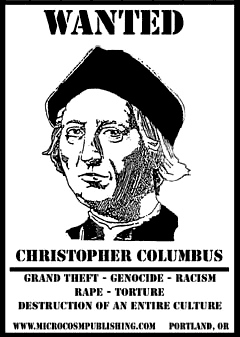
Columbus Blog #8
Christopher Columbus Blog #9
Wednesday, September 25, 2013
LAD #7: Washington's Farewell Address
To begin, Washington states that he does not want to be reelected and he believes it is time for someone new to be the head of the government. In his address, president Washington asks the nation to confirm three principles. The first, is that sectional antagonism should come to an end in the United States, because they cause nothing but a weaker nation. The second request, was that they discourage the formation of parties, since those parties divided people and influenced the government to support the party rather than the people. Lastly, Washington warned against the formation of permanent alliances, which would eventually drag the colonies into conflicts. Washington suggested that America keeps a policy of neutrality rather than joining alliances, which he believed would save American lives in the big picture. Washington also included advice about staying out of debt, and how that led to taxes which led to overall unhappiness for the colonists. He also suggested America should maintain the values and morals they had founded in order to create the best life for its citizens. One last thing Washington mentioned, was that the United States should not rely too much on military, as it could lead to a takeover. President Washington's decision to leave also left a footprint in history such as two term presidency and the formation of a Cabinet.
LAD #6: Washington's Proclamation of Neutrality
To summarize, President Washington begins by statin that the United States would remain neutral in the conflict between European powers. He also encouraged American citizens to refrain from any behavior that might compromise the proclamation. He stated that if any citizen does compromise the proclamation, that they will lose the protection of the United States and be subjected to a court of law where they will be prosecuted due to their actions.
Tuesday, September 24, 2013
LAD #5: Federalist #10
1.) Why are factions so difficult to eliminate?
Factions are difficult to eliminate because the liberty that gives rise to them is important to political life as well. Removing liberty ruins the whole system. Madison says that mankind will continue improving itself as long as there is freedom of opinion and the different factions continue to be formed. The difference of at least one faction allows that there will always be an opinion that could improve life for the people.
2.) If factions cannot be removed then how can they be controlled?
Factions can be controlled in many ways. If the top faction is placed in power and can use the faction's majority to rule over the other factions. Madison also states that it could be possible to try to stamp out other factions, leaving one remaining faction. This would result in totalitarianism. Madison previously stated that more than one factions needs to exist in order to have peace in the nation.
Sunday, September 22, 2013
Republican Motherhood Blog
1.) What role did the Revolutionary War play in
the transformation of housewifery to Republican
Motherhood?
Women's status was changed by the Revolutionary War from housewife to their children to the base of colonial society. Women were then meant to prepare their children for the future and teach them values according to the American way of life. Eventually, women would become the head of the household and make sure their children have obtained the skills and knowledge necessary for daily life in American society.
2.) What were the consequences of Republican Motherhood on women?
A decrease in the amount of working women was an outcome of Republican Motherhood. Women were now supposed to be the rulers of their household, prepare their children for outside the home and overall devote themselves to domestic life. For women who still had a job, this was nearly impossible, so many of them quit and decided to focus on their families. Another consequence of Republican Motherhood was the average family size decreased as birth rates dropped. This was because mothers were now becoming attached to individual children rather than the family as a whole. This was done in order to prepare the boys to grow up and work in the government or politics and the girls to become good wives and Republican mothers.
3.) What is the significance of the ideology of Republican Motherhood as a stage in the process of women’s socialization?
As women gained access to more power, education, and responsibility from Republican Motherhood, they began to crave more and more, eventually leading to the 1848 Senaca Falls Convention. Without Republican Motherhood, women may not have the freedoms they do today mostly because it became a steppingstone in the Civil Rights movement and began to change history.

1.) Describe the setting. A woman and two children sit in front of a simple gray background, dressed plainly, there is no evidence of extreme wealth or prestige. Their clothing is simple and appears to be a traditional republican setting.
2.) Who serves at the center of the portrait and why? How does the woman look? How is she “republican” rather than aristocratic?
A.) Mary Tilghman is the center of the portrait. She is a Republican mother. She is most likely in the center of the portrait because she was the head of the household and everything that happened was subject to her rule, and she as the Republican mother, reshaped the domestic scene of America.
B.) She appears to be simple, no jewelry or any presence of wealth.
C.) This portrait makes Mary Tilghman appear to be more traditional republican rather than an aristocrat who would no be portrayed so simply. An aristocrat would be painted with an exciting background and with lots of jewelry and makeup.
3.) What values do her sons exhibit? Friendly, happy, obedient to their mother.
4.) Is there a significance to the position of Mrs. Tilgham’s arm? Yes, the position and location of Mrs. Tighman's arm displays her power and control that exists within her household. Her arm position on the child claims it as hers and her responsibility to care for and prepare the child for American society outside the house.
Women's status was changed by the Revolutionary War from housewife to their children to the base of colonial society. Women were then meant to prepare their children for the future and teach them values according to the American way of life. Eventually, women would become the head of the household and make sure their children have obtained the skills and knowledge necessary for daily life in American society.
2.) What were the consequences of Republican Motherhood on women?
A decrease in the amount of working women was an outcome of Republican Motherhood. Women were now supposed to be the rulers of their household, prepare their children for outside the home and overall devote themselves to domestic life. For women who still had a job, this was nearly impossible, so many of them quit and decided to focus on their families. Another consequence of Republican Motherhood was the average family size decreased as birth rates dropped. This was because mothers were now becoming attached to individual children rather than the family as a whole. This was done in order to prepare the boys to grow up and work in the government or politics and the girls to become good wives and Republican mothers.
3.) What is the significance of the ideology of Republican Motherhood as a stage in the process of women’s socialization?
As women gained access to more power, education, and responsibility from Republican Motherhood, they began to crave more and more, eventually leading to the 1848 Senaca Falls Convention. Without Republican Motherhood, women may not have the freedoms they do today mostly because it became a steppingstone in the Civil Rights movement and began to change history.
1.) Describe the setting. A woman and two children sit in front of a simple gray background, dressed plainly, there is no evidence of extreme wealth or prestige. Their clothing is simple and appears to be a traditional republican setting.
2.) Who serves at the center of the portrait and why? How does the woman look? How is she “republican” rather than aristocratic?
A.) Mary Tilghman is the center of the portrait. She is a Republican mother. She is most likely in the center of the portrait because she was the head of the household and everything that happened was subject to her rule, and she as the Republican mother, reshaped the domestic scene of America.
B.) She appears to be simple, no jewelry or any presence of wealth.
C.) This portrait makes Mary Tilghman appear to be more traditional republican rather than an aristocrat who would no be portrayed so simply. An aristocrat would be painted with an exciting background and with lots of jewelry and makeup.
3.) What values do her sons exhibit? Friendly, happy, obedient to their mother.
4.) Is there a significance to the position of Mrs. Tilgham’s arm? Yes, the position and location of Mrs. Tighman's arm displays her power and control that exists within her household. Her arm position on the child claims it as hers and her responsibility to care for and prepare the child for American society outside the house.
Tuesday, September 17, 2013
Blog #4 - Revolution Article
5 Things i Learned When Reading the Article
- When compared to Civil War paintings, works of art featuring battles from the Revolution showed no signs of fighting, blood, dead bodies, or shooting.
- The Civil War killed more American Soldiers than any other war since. This is because the war consisted of Americans fighting other Americans
- Few people can name a Revolutionary soldier other than Washington, John Paul Jones, and Benedict Arnold (including me).
- Eighteenth century armies, in order to make their fighting more effective, fought at a close range, leading engagements to end in hand to hand combat and violent bayonet charges.
- The Revolutionary war is the longest war recorded in American history
Sunday, September 15, 2013
LAD #3: The Declaration of Independence
1.) The Declaration of Independence begins with the fact that citizens of the United States are entitled to democratic principles which are guaranteed and cannot be taken away from them. For example, the democratic principle that all men have certain unalienable rights such as life, liberty, and the pursuit of happiness. Another example established in the declaration is that the responsibility of the government is to protect the people and these unalienable rights. The people have the rights to alter or throw off of the government if they do not succeed.
2.) Once the Declaration of Independence was created and the democratic principles were established for the government, they began a list of complaints and complaints against Britain. Some of the complaints have to do with interfering with the colonies and foreign countries. For example, the British cut off the colonies trade with all the other parts of the world besides themselves, imposed taxes on the colonies without asking, forcing the colonists to hold large amounts of soldiers in their homes, depriving them of trial by jury, and several other grievances that disregarded the basic rights the colonists were entitled to.
3.) The democratic system of government was established by representatives of the United States from all different colonies. The representatives also declared separation from Great Britain. The Declaration of Independence declares officially that the colonies of America are free and independent states and are no longer connected politically to Great Britain. They now have the power to make peace, declare war, trade freely, and form their own allies as independent states. The declaration represented the colonists freedom from Britain and was able to establish a foundation for the future of the United States of America.
Subscribe to:
Posts (Atom)


.jpg)